


-

"I used to Google every question my son asked. Now he grabs this book before he even asks me. Honestly the best book I've bought this year."

Why? World Kids Encyclopedia
Why? World Kids Encyclopedia
UPDATE: Selling out FAST - hundreds ordered this week alone. Last copies left in stock.
Builds confidence, vocabulary & love of learning
Answers the questions your child already asks
Screen-free learning your child chooses
BUNDLE & SAVE
Couldn't load pickup availability
100% money-back guarantee

Why? World Kids Encyclopedia
What's inside?
What's inside?
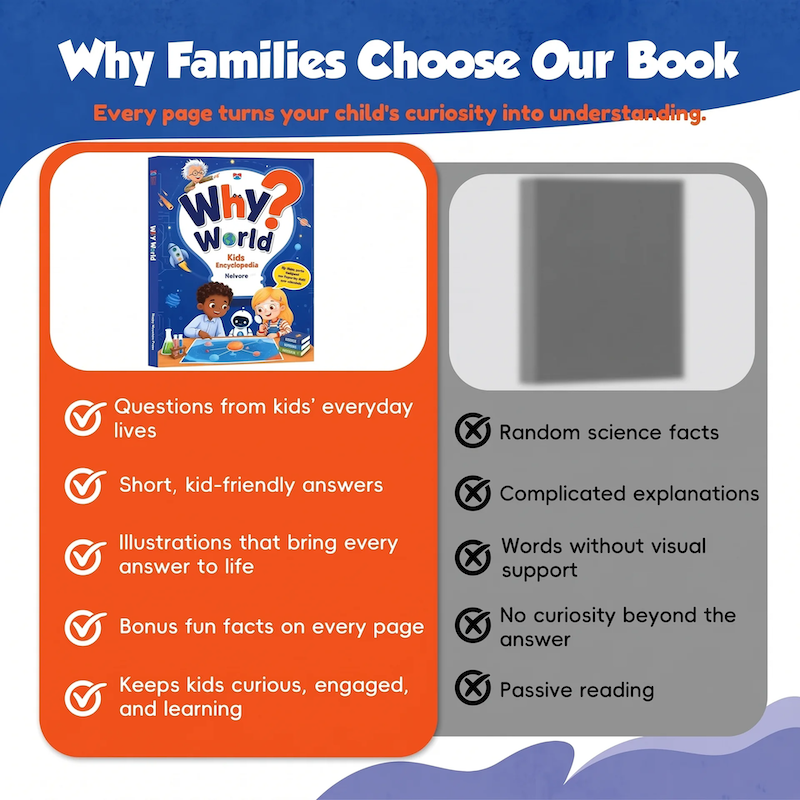
Why? World Kids Encyclopedia is 174 illustrated pages of the questions your child actually asks - organised into eight themed chapters and written in a voice a 6-year-old can follow and a 12-year-old still respects.
Every question follows the same clear format:
The Question - written in a curious kid's own words
The Answer - simple, accurate, and short enough to hold their attention
A Fun Fact - the "wait, really?" moment that
makes them remember it
A full-color Illustration - because a picture makes it stick
Inside the 8 chapters, your
child will explore: the human body, daily life, plants, animals, technology and inventions, the environment and earth, astronomy and geography, and the science of tomorrow.


Feed the curiosity, without becoming Google
It's easy to fall into the habit of reaching for your phone every time your child asks a question you can't answer.
Without realising those are the exact moments where curiosity turns into confidence, or quietly fades away by middle school.
That's why "Why? World" Encyclopedia was created: to help you replace "I don't know" with "let's find out together" - and give your child a book they'll come back to on their own.
🧠 become the parent your child comes to with answers
✓ suitable for curious kids ages 6 to 12

Stop being your child's search engine, for the better
If you've ever frozen mid-sentence when your child asked "why is the sky blue?" or reached for your phone when the fifth "but why?" of the morning landed - you're not the problem, and you're not alone.
Why? World gets to the questions kids actually ask and gives you answers you can trust, without you having to memorise an encyclopedia.
Written for curious kids ages 6 to 12, every one of the 174 questions is paired with a simple answer, a fun fact, and a full-color illustration your child will actually remember - so the answers stick long after the moment passes.
🗣 174 real questions, answered in language your child understands
Here's How It Works
These are the four worlds your child explores as their curiosity turns into real understanding.
Collapsible content
Step I - The World Inside You: Chapters 1–2
Step I - The World Inside You: Chapters 1–2
Chapter 1 - Human Body. Why does our stomach rumble when we're hungry? Why do we dream? The chapter that turns your child's own body into their first great mystery.
Chapter 2 - Daily Life. Why does a fridge keep food fresh? Why can we taste flavours? The everyday-object questions your child asks constantly, finally answered.
Step II - The Living World: Chapters 3–4
Step II - The Living World: Chapters 3–4
Chapter 3 - Plants. Why are mushrooms not plants? Why do leaves change color? The chapter that opens your child's eyes to the quiet world under their feet.
Chapter 4 - Animals. Why can fish breathe underwater? Why do cats purr? The chapter every animal-obsessed kid will read three times.
Step III - The Built World: Chapters 5–6
Step III - The Built World: Chapters 5–6
Chapter 5 - Technology and Inventions. How do phones access the internet? How does a microwave heat food? The "how does this thing actually work?" chapter.
Chapter 6 - Environment and Earth. Why is seawater salty? Why do volcanoes erupt? The chapter that gives your child a lifelong sense of how the planet works.
Step IV - The World Beyond: Chapters 7–8
Step IV - The World Beyond: Chapters 7–8
Chapter 7 - Astronomy and Geography. Why is the sky blue? Why does the moon change shape? The chapter that turns the ceiling of the world into a beginning, not an end.
Chapter 8 - Science of Tomorrow. Will future cars fly? What will AI be able to do? The chapter that lets your child imagine their own future - with facts, not fear.
Over 7,900+ curious kids and grateful parents…
-

She reads it to me now
Bought this for my daughter thinking I'd end up reading it to her. A week in, she's the one reading pages out loud to me at breakfast. She told me why our hearts keep beating yesterday. I didn't know either.
-

Better than the phone, honestly
He used to ask Alexa. Now he grabs this. That alone was worth the price. My favourite chapter is the human body one - he told me why we sneeze last week and I actually learned something too.
-

Grandkid gift that actually stuck
I got this for my granddaughter's eighth birthday and she called me three times over the following week to tell me things she'd read. Best forty dollars I've ever spent on a gift.
-

The"but why?" phase finally has a home
I've bought at least four "why" books trying to keep up with my seven-year-old. This is the first one he actually chose to read on his own. He tells me the fun facts at dinner now, which is a first.


FAQ
What ages is this actually right for?
What ages is this actually right for?
Why? World is written for curious kids ages 6 to 12, and the way it works shifts with your child's age. Younger kids (4–5) love it as a read-aloud - the illustrations are the hook. By 6–8, most kids browse the short answers and fun facts on their own. By 9–12, they read the full explanations and start quoting them at dinner. If you're gifting for a wide sibling age range, one copy usually gets shared.
Will my child actually read it, or will it sit on a shelf?
Will my child actually read it, or will it sit on a shelf?
The book is designed to reward flipping through, not just cover-to-cover reading. Every page has a bold "why?" question, a short answer, a fun fact, and a full-color
illustration — the same format that makes kids come back to a magazine again and
again. The most common message we get from parents is that their child picked it up on their own within the first week, and then again the week after that.
Does a parent have to read it with them, or can my child use it on their own?
Does a parent have to read it with them, or can my child use it on their own?
Both - and that's the point. The
short-answer format and the illustrations are built for a kid to browse independently, which is what most 8-and-up readers do. But it also works beautifully as a one-page-a-night bedtime routine with a younger child. Plenty of parents use it both ways in the same week: solo reading during quiet time, then a shared page or two at bedtime.
Need help?
We got you! Our support team is available 7 days a week to assist you with every possible worry - just message infonelvore@gmail.com & we will be more than pleased to help you.
Free & easy returns
No stress, no hassle. If you need to return your order, we make it simple. Our team is here 7 days a week to help you every step of the way.